
Woolworths has announced a majority stake in Petspiration Group for $586 million, at an EV/EBITDA of 11x. This is a full price, particularly given Woolworths will deliver the majority of the synergies. We are concerned that industry-wide revenue may recede given the COVID-19 pet boom added more than 2.5m dogs and cats to households. Woolworths is building out its “ecosystem” and Petspiration is a natural extension. However, the more important share price driver is Australian Food, which needs to demonstrate that previous capex is delivering a return on investment.
The shape of the recovery in Australian tourism remains a tailwind, not a headwind for retail. As at December 2022, Australians are still over-indexing on local stays. This tends to boost sales in supermarkets, liquor, apparel, pubs, restaurants and cafes. In addition, recent data also shows net migration is recovering rapidly. If current trends hold, by June 2023, population growth could be 1.5%, compared with 1.0% for the year to June 2022. This step-up in population will partly cushion the impending downturn in retail spending. We expect any downturn in retail sales is more likely around June 2023, not earlier.
Australia vs New Zealand retailing - Are there parallels across the ditch?
10 December 2022
Many Australian retailers have a presence in New Zealand. However, not all are successful in that market. In Issue 5 of TheRetail Mosaic, we analyse the consumer, retail structure and profitability of retailers in NZ. Even though the consumer has similar attributes, growth rates diverge often. While some retail segments are more consolidated, many Australian retailers with operations in NZ lack scale.
Australian retail is setup for a good Christmas this year. The growth rates leading into Christmas has been far stronger than last year and while supply chains are not seamless, they are functioning better. Our feedback indicates low single digit sales growth for many with some stronger anecdotes. Given the timing of Omicron last year, sales feedback should strengthen further into Christmas and January 2023. We expect strong trading to lead to upside risk in near-term earnings for retailers.
Some relief on the horizon for commodity prices and food inflation
09 December 2022
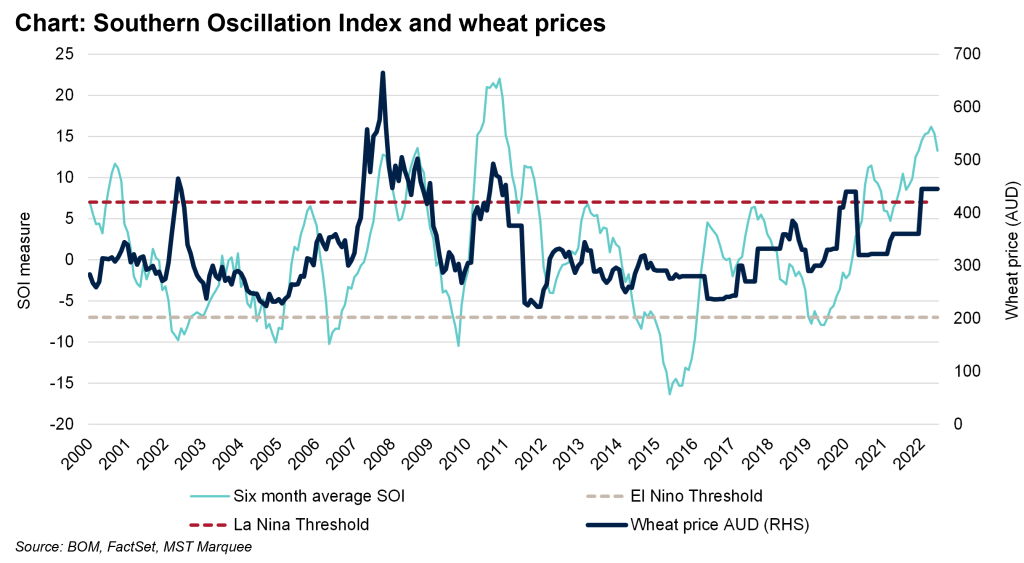
For all Australians, it is welcome news to hear that the drivers of excessive rainfall may be easing. The Bureau of Meteorology is suggesting La Nina may be over by January or February 2023. In addition to more favourable weather, there is a silver lining for everyone because growing conditions will improve around the world. La Nina creates dry conditions for many northern hemisphere countries and tends to lift prices for soft commodities like wheat. As shown below, the wheat price tends to be higher when the Southern Oscillation Index is high (La Nina) and wheat prices tend to be lower when the Southern Oscillation Index is low (El Nino). Some of the drivers of inflation should diminish as La Nina eases.
The National Accounts highlights the pinch from higher interest rates starting to show through. Household income rose 3.6% in the September 2022 quarter, down from 6.5% in the June quarter. However, savings rates are the cushion that will continue for the next six months, preventing a retail sales downturn till mid next year. Savings dropped from 8.3% in June to 6.9% in September. The stored up savings in the bank over past 2.5 years have not been used, which keeps consumers personally confident despite a multitude of macro-economic headlines that spooks sentiment. We expect a good Christmas for retail and even decent March 2023 quarter. Retail sales will slow meaningfully, just not yet.
Australian retail sales growth for October 2022 was 12.0% year-on-year. This is still elevated given part of the month was impacted by lockdowns last year. Once again, three-year CAGR growth rates are more relevant. On that basis, recreational goods, liquor and department stores slowed. It is important to note, we will be back to single-digit industry sales growth in November given the very high base line from 2021. A more noticeable slowdown will be evident in the June quarter 2023.
Metcash’s reported 1H23 sales growth of 8% and EBIT growth of 10%. Price inflation drove more than half the sales growth and will remain a key driver over the next 12 months. There will be some normalisation in Hardware sales, but its mix of business supports margins. The Food business will benefit from stock profits and is holding market share. While 1H23 had weak cash flow, the result will mostly normalise in 2H23e and a higher working capital position is the reality of having more hardware and less tobacco sales.
City Chic’s 2022 AGM trading update highlighted a normalisation in sales and squeeze in profit margins for FY23e. We expect FY23e EBITDA pre AASB-16 to fall to $19 million. While a low point, profitability should recover as the industry-wide inventory position normalises over the next year. We have structurally dropped our sales forecasts given Avenue looks to be resetting sales lower like many online businesses. We expect EBITDA margins to trough at 5.6% this year and recover to 11.8% by FY25e.
Harvey Norman has provided an AGM update that reflects the strength of the consumer in many of its markets. Australian comparable sales rose 8.8% and the three-year CAGR is 8.0%. Slovenia and Ireland are also very strong. Given good sales results, we expect profit margins to only fall slightly in FY23e. If Harvey Norman can reduce its inventory levels in an orderly manner, the margin compression could be less than feared.