• Sort by

  • Industry

Toggle intro on/off

Presentation: Retail forecasts update April 2025

What happens next?

02 May 2025

This is a chart pack from our webinar presentation following our April 2025 updated retail forecasts. The chart pack addresses the retail sales outlook, household income growth and savings. We also address the topical issues of US tariffs, the Australian dollar and wage rate growth. The presentation pack has a link to the webinar recording.

Retail forecasts for 2025 - quarterly update

What happens next?

01 May 2025

We have updated our forecasts for the Australian retail sales outlook. Despite significant global uncertainties created by US tariffs, Australian consumers have taken it in their stride. We forecast retail sales growth for 2025 of 3.4% (prev 3.6%). Our downgrade in growth is only for supermarkets and liquor with softer volumes and price inflation. Non-food retail has started the year strongly, particularly in household goods and online. The strength in retail sales is largely attributable to strong household income growth and the drivers of this elevated growth will be difficult to sustain given the magnitude of recent tax cuts and outsized population growth. A better backdrop would require consumers to save even less. We expect sales growth of 4% beyond 2025.

Price Watch Issue 6 - Retail price drivers

The lead indicators for retail prices

07 July 2023

Like most countries, Australian retail price inflation is elevated, but looks to be peaking. In Issue 6 of Price Watch, we uncover the key lead indicators of retail price inflation. We find that price changes are well correlated globally in electronics and food. Sea freight rates are a good predictor of retail prices alongside some input price indices. The spot observations on all of these indicators suggest Australian retail price inflation is likely to fall meaningfully over the next 12 months and contribute to a slowdown in retail sales growth. We may even see deflation in categories like electronics and apparel.

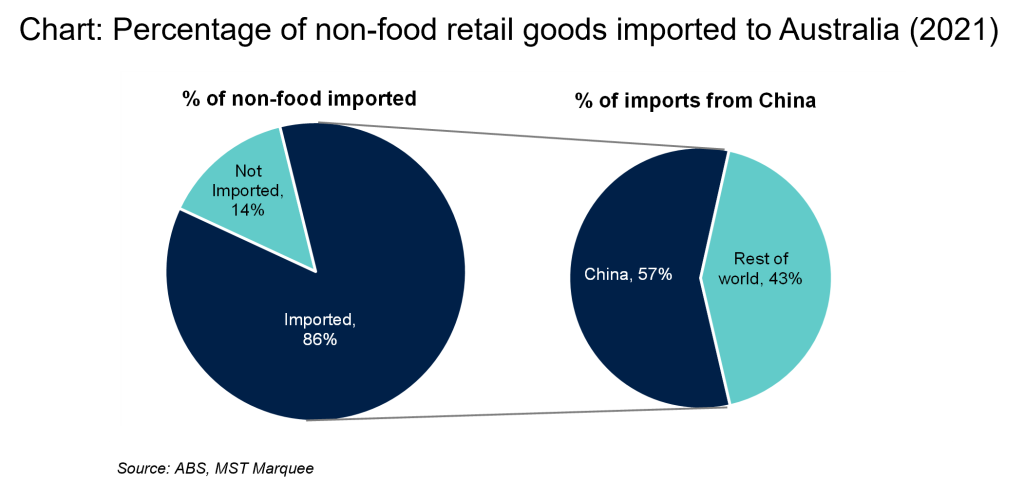
As global trade tensions build and geopolitical risks rise, we think Australian retailers are going to need to diversify their supply chains. Australia imports ~86% of its non-food consumer goods and we estimate 57% of these imports come from China. The productivity of China has led to a concentration of sourcing that represents a real risk on a 5-10 year horizon as Chinese wage rates rise further, supply chains face further disruptions and trade tensions rise. Electronics is the most at-risk category entirely imported, with 56% of imports from China, followed by clothing and accessories at 94% imported, with 55% from China.

Search result for "" — 625 articles found

Not already a member?
Join now to get all the latest reports in full and stay informed.

Get started